Showing posts with label Technology. Show all posts

Friday

The Baikonur Cosmodrome

The Baikonur Cosmodrome - part 1

When NASA's last scheduled Space Shuttle mission lands in June of 2010, the United States will not have the capability to get astronauts into space again until the scheduled launch of the new Orion spacecraft in 2015. Over those five years, the U.S. manned space program will be relying heavily on Russia and its Baikonur Cosmodrome facility in Kazakhstan. Baikonur is an entire Kazakh city, rented and administered by Russia. The Baikonur Cosmodrome was founded in 1955, making it one of the oldest space launch facilites still in operation. Here are collected some photographs of manned and unmanned launches from Baikonur Cosmodrome over the past several years.
The Baikonur Cosmodrome - part 2
The Soyuz TMA-3 spacecraft and its booster rocket, transported by rail to the launch pad to be raised to a vertical launch position at the Baikonur Cosmodrome, Kazakhstan on October 16, 2003, in preparation for liftoff October 18 to carry C. Michael Foale, Expedition 8 commander and NASA science officer; Alexander Kaleri, Soyuz Commander and flight engineer; and European Space Agency (ESA) astronaut Pedro Duque of Spain to the International Space Station. (NASA/Bill Ingalls)
The Baikonur Cosmodrome - part 3
A view of the bottom of the booster rocket for the Soyuz TMA-6 spacecraft, shortly after the two were mated at an integration facility at the Baikonur Cosmodrome in Kazakhstan on April 12, 2005. (NASA/Bill Ingalls)
The Baikonur Cosmodrome - part4
Soyuz TMA-11 prime and backup crewmembers are protected behind glass during the State Commission meeting and press conference Oct. 9, 2007 at the Baikonur Cosmodrome in Kazakhstan. The crew was in preparation for their launch to the International Space Station Oct. 10 in their Soyuz TMA-11 spacecraft. (NASA/Bill Ingalls
The Baikonur Cosmodrome - part5
NASA astronaut Peggy A. Whitson, Expedition 16 commander, has a pressure suit leak check performed on her Russian Sokol launch and entry suit at RSC Energia Assembly and Testing Facility in Baikonur, Kazakhstan, in preparation for her launch on a Soyuz TMA-11 spacecraft to the International Space Station scheduled for Oct. 10. (NASA/Victor Zelentsov)
The Baikonur Cosmodrome - part6
Russian cosmonaut Yuri Lonchakov (C), US astronaut Michael Fincke (L) and his compatriot, space tourist Richard Garriott (R) practice inside a Soyuz-TMA space flight simulator in Star City (a training facility north of Moscow, Russia) on September 19, 2008. (DMITRY KOSTYUKOV/AFP/Getty Images)The Baikonur Cosmodrome - part7
Cosmonaut Salizhan S. Sharipov, Russia's Federal Space Agency Expedition 10 flight engineer and Soyuz commander, donned his launch and entry suit and climbed aboard the Soyuz TMA-5 spacecraft October 5, 2004, at the Baikonur Cosmodrome in Kazakhstan for a dress rehearsal of launch day activities leading to their liftoff October 14 to the International Space Station. (NASA/Bill Ingall)

The Baikonur Cosmodrome - part8

Astronaut Leroy Chiao (r), Expedition 10 commander cosmonaut Salizhan S. Sharipov (c), and Russian Space Forces cosmonaut Yuri Shargin (l) donned their launch and entry suits and climbed aboard the Soyuz TMA-5 spacecraft October 5, 2004, at the Baikonur Cosmodrome in Kazakhstan for a dress rehearsal of launch day activities leading to their liftoff October 14 to the ISS. (NASA/Bill Ingalls)

The Baikonur Cosmodrome - part9
At the Baikonur Cosmodrome in Kazakhstan, Expedition 17 Commander Sergei Volkov (center), Flight Engineer Oleg Kononenko (right) and South Korean spaceflight participant So-yeon Yi bid farewell to well wishers April 8, 2008 prior to heading to the launch pad for their liftoff on the Soyuz TMA-12 spacecraft to the International Space Station. (NASA /Victor Zelentsov)

The Baikonur Cosmodrome - part10

Railroad tracks lead to the Baikonur Cosmodrome launch pad. Soyuz TMA-8 spacecraft and its booster were rolled out on March 28, 2006, for final pre-launch preparations. The Soyuz was set to blast off on March 30, 2006, (NASA/Bill Ingalls)

The Baikonur Cosmodrome - part11

The Soyuz TMA-12 spacecraft is rolled to its launch pad at the Baikonur Cosmodrome in Kazakhstan April 6, 2008 in preparation for launch April 8 to carry new residents and a spaceflight participant to the International Space Station. The Soyuz began the move from its assembly and integration building to the launch pad on a railcar at sunrise, arriving at the pad several hours later for final technical preparations. (NASA /Victor Zelentsov)

The Baikonur Cosmodrome - part12

With a mockup of the defunct Russian "Buran" Space Shuttle sitting passively nearby (lower right), the Soyuz TMA-3 spacecraft and its booster rocket crawl on a rail car to the launch pad at the Baikonur Cosmodrome, Kazakhstan October 16, 2003, in preparation for its liftoff October 18 to carry three astronauts to the International Space Station. (NASA/Bill Ingalls)

The Baikonur Cosmodrome - part13
Baikonur hosts both manned and unmanned launches. Here is shown a Russian Proton-M rocket carrying a Canadian communication Nimiq 4 satellite being transported to a launching pad of the Baikonur Cosmodrome on September 15, 2008. The Proton-M will carry the satelite into geostationary orbit on September 18, 2008. (STR/AFP/Getty Images)


The Baikonur Cosmodrome - part14

Spectators try to grab the highest viewing point to watch the launch of the Soyuz TMA-8 spacecraft, carrying Expedition 13 crew members to the International Space Station on March 30, 2006. (NASA/Bill Ingalls)

The Baikonur Cosmodrome - part15

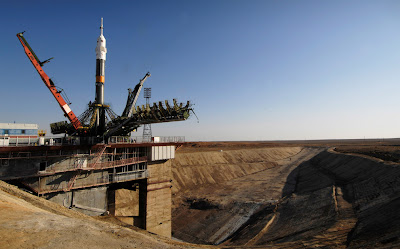
Preparations are underway for liftoff of the Soyuz TMA-11 spacecraft as the Soyuz-FG launch vehicle with the Soyuz spacecraft is installed on the launch system and the transporter-emplacer arm moves away, October 8, 2007 (NASA/Bill Ingalls)

The Baikonur Cosmodrome - part16

A Soyuz spacecraft lifts off from the Baikonur Cosmodrome, Kazakhstan, at 10:54 p.m. (CDT) on April 26, 2003. Onboard were cosmonaut Yuri I. Malenchenko, Expedition Seven mission commander, and astronaut Edward T. Lu, NASA ISS science officer and flight engineer. Malenchenko represents Rosaviakosmos. (NASA/Scott Andrews)


The Baikonur Cosmodrome - part17

The Soyuz TMA-6 spacecraft seen high overhead as it blasts off from the Baikonur Cosmodrome in Kazakhstan at daybreak on April 15, 2005 (Kazakhstan time), carrying three astronauts to the ISS. (NASA/Bill Ingalls)


The Baikonur Cosmodrome - part18
Backdropped by a cloud-covered Earth, the Soyuz 14 (TMA-10) spacecraft approaches the International Space Station. Onboard the spacecraft are cosmonauts Fyodor N. Yurchikhin, Expedition 15 commander; and Oleg V. Kotov, Soyuz commander and flight engineer, both representing Russia's Federal Space Agency; along with spaceflight participant Charles Simonyi. With Kotov at the controls, the Soyuz linked up to the ISS on April 9, 2007
The Baikonur Cosmodrome - part19
The flags of Malaysia, Russia and the United States sit between the phones used by officials to talk to the crew of the International Space Station in the Russian Mission Control Center in Korolev, outside Moscow, seen on October 12, 2007. (NASA/Bill Ingalls)


The Baikonur Cosmodrome - part20

Seen in front of the Earth's horizon and the blackness of space, the Soyuz TMA-9 spacecraft approaches the International Space Station. Onboard the spacecraft are astronaut Michael E. Lopez-Alegria, Expedition 14 commander and NASA space station science officer; cosmonaut Mikhail Tyurin, Soyuz commander and flight engineer representing Russia's Federal Space Agency; and spaceflight participant Anousheh Ansari. The Soyuz linked up to the Zvezda Service Module aft port at on Sept. 20, 2006.(NASA)

The Baikonur Cosmodrome - part21

Backdropped against the blackness of space and airglow of Earth's horizon, an unpiloted Progress supply vehicle approaches the International Space Station (ISS). The Progress 15 resupply craft launched August 11, 2004 from the Baikonur Cosmodrome in Kazakhstan to deliver almost three tons of food, fuel, oxygen, water and supplies to the Expedition 9 crewmembers onboard the Station. (NASA)


The Baikonur Cosmodrome - part22

The Baikonur launch complex, seen directly in a photograph taken by an Expedition 13 crew member aboard the International Space Station on September 9, 2006. The name Baikonur is Kazakh for "wealthy brown," i.e. "fertile land with many herbs." (NASA)


The Baikonur Cosmodrome - part23
A Kazakh farmer herds cattle across the tarmac on April 19, 2008, at the Arkalyk airport in Kazakhstan. Arkalyk is used as one of the helicopter staging areas for the landing of the Soyuz spacecraft, as they parachute back to Earth. (NASA/Bill Ingalls)

The Baikonur Cosmodrome - part23

The city of Baikonur, Kazakhstan, is seen from the aircraft carrying Expedition 10 crew members on October 4, 2004. The crew will prepare for their launch on the Soyuz TMA-5 spacecraft October 14, 2004, to the ISS. (NASA/Bill Ingalls)
The Baikonur Cosmodrome - part24

A series of three photographs shows the Soyuz TMA-9 spacecraft floating to a landing southwest of Karaganda, Kazakhstan at approximately 6:30 p.m. local time on April 21, 2007. Onboard were astronaut Michael E. Lopez-Alegria, Expedition 14 commander and NASA space station science officer; cosmonaut Mikhail Tyurin, Soyuz commander and flight engineer representing Russia's Federal Space Agency; and U.S. spaceflight participant Charles Simonyi. (NASA)

The Baikonur Cosmodrome - part25

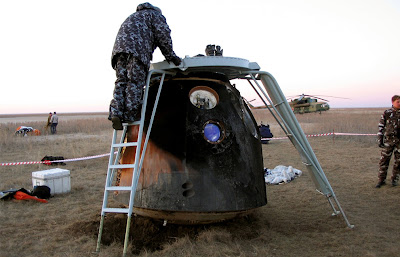
Technicians begin the process of removing cargo from the Soyuz TMA-7 capsule (blackened from the heat of re-entry) at sunrise on the steppes of Kazakhstan on April 9, 2006, following the pre-dawn landing of three ISS Expedition 12 crew members. (NASA)

The Baikonur Cosmodrome - part26

Expedition 13 crewmembers - cosmonaut Pavel V. Vinogradov (center), commander, and astronaut Jeffrey N. Williams (right), flight engineer and NASA ISS science officer - along with spaceflight participant Anousheh Ansari are attended to by Russian and American search and recovery teams on the steppe of central Kazakhstan on Sept. 29, 2006 following their landing in the Soyuz TMA-8 spacecraft after undocking earlier in the day from the International Space Station. (NASA)


Wednesday

BMW 2015 Concept by Transportation Design students

BMW 2015 - The final projects of the Transportation Design students at Turin-based IED (istituto Europeo di Design) - part1


The final projects of the Transportation Design students at Turin-based IED (istituto Europeo di Design), developed in partnership with BMW with the goal of creating a car for 2015 interpreting the language evolution and the brand's philosophy. The image is the BMW ZX-6 Concept by Jai Ho Yoo and Lukas Vanek. The 8 final 1:4 scale models will be displayed at the Istituto Europeo di Design, in Via S. Quintino 39, Turin.


BMW 2015 - The final projects of the Transportation Design students at Turin-based IED (istituto Europeo di Design) - part2


Projects development
During the first phase of the project students were involved in the research of a product and a style projected towards the future, for their subsequent application to actual scenarios of a close tomorrow.


BMW 2015 - The final projects of the Transportation Design students at Turin-based IED (istituto Europeo di Design) - part3


Initially, students’ concept work focused on individuating wishes, needs, tastes and life style of an individual (man or woman) meant to turn 35 years old in 2025.
As to shapes development, they were asked to find an inspiration source looking both into natural elements like the sun, the sea, the wind or the earth and in forms of expression such as music, painting or arts in general.


BMW 2015 - The final projects of the Transportation Design students at Turin-based IED (istituto Europeo di Design) - part4


For the second phase of the project, young car designers had to use the project essence and formal language individuated in the previous stage to develop both the interior and exterior of an actual car suitable to fit in an hypothetical 2015 life context and able to generate emotions while also identifying the BMW profile.


BMW 2015 - The final projects of the Transportation Design students at Turin-based IED (istituto Europeo di Design) - part5


Students were also followed throughout the internal stages of project development by a BMW Commission including Thomas Plath, Director Model Techniques and Process Management, and Anders Warming, BMW Exterior Design Director, under the supervision of Chris Bangle, Chief of Design for BMW Group.


BMW 2015 - The final projects of the Transportation Design students at Turin-based IED (istituto Europeo di Design) - part6


The proposals elaborated by all student teams were later evaluated with the selection of 12, out of which 8 were developed in 1:4 models, in collaboration with Cecomp, and the remaining 4 turned into virtual models.


BMW 2015 - The final projects of the Transportation Design students at Turin-based IED (istituto Europeo di Design) - part7


Projects particularly appreciated by the commission included: “Africa. decompose concept.” by Raphael Laurent and Mihaï Panaîtescu and “Snug” by David Raffai, Kevin Schlaepfer, Andrea Torchia and Alberto Usai.


BMW 2015 - The final projects of the Transportation Design students at Turin-based IED (istituto Europeo di Design) - part8


AFRICA - decompose Concept
Authors: Raphael Laurent and Mihai Panaitescu
Project Concept
Taking inspiration from African lifestyle, tradition and art; searching for unique ways of thinking, different from modern ones and creating culture design.
Designing a car for future Africans gives the possibility to rethink vehicles that really fit their owners, through aesthetics, mentality and way of use.
The vehicle deconstructs itself in order to fit different daily needs. The design language is developed as to facilitate the concept, taking in account the African culture and artistic expression.


BMW 2015 - The final projects of the Transportation Design students at Turin-based IED (istituto Europeo di Design) - part9


SNUG Concept
Authors: David Raffai, Kevin Schlaepfer, Andrea Torchia and Alberto Usai
Project Concept:
"In the future metropolis, which will be more and more chaotic, confusing, grey and polluted, we risk becoming automatons, slaves to money and personal success: not accepting the intrinsic naturalism of the human being; ready, instead, for selection and competition, forgetting about individual diversity and the respect of pure ideas, which separate us from cold, mechanic industrialization.
"Escape, via art, from the objective conception of things, choosing instead authentic, non-contaminated expression."
SNUG is a concept which aims to create a sense of community: a simple, fun object, designed for people who appreciate personal relationships, people who are different from the others, in their opinions and in their feelings.


Friday

The End of the World - Next Week’s Particle Collision Test Delayed


The End of the World part1

Those unneccesarily worried about the world’s end next week when the Large Hadron Collider (LHC) was scheduled to begin smashing its first particles will be delighted to know that the test has been postponed after a significant fault was detected on Friday. A technician found that one of the accelerator’s superconducting magnets was out-of-sync during routine testing.


The End of the World part2
This is of concern because the supercooled helium that chills the LHC’s magnets to 1.8 degrees centigrade above absolute zero was released into the accelerator’s 17-mile tunnel in the incident. Engineers were still investigating the extent of the problem Friday afternoon, and CERN officials could not say how long it would take to fix it or how long of a delay this will cause in the proposed atom smash.


The End of the World part3
“It certainly means we will not have collisions on Monday,” stated James Gillies, CERN’s chief of communications. “We are now looking at the middle of next week at the earliest.”

Canon EOS 5D Mark II DSLR camera shoots pro stills, 1080p video


Canon EOS 5D Mark II


Canon just rolled out a monster DSLR camera – the Canon EOS 5D Mark II. Yes, the Canon EOS 5D Mark II is not going to be cheap when it's available in November ($2700 for the body, lenses extra), but for that wad of cash the Canon EOS 5D Mark II brings along a professional feature set that's never been seen before. Besides Canon EOS 5D Mark II hot shooting capabilities, the Canon EOS 5D Mark II is the first digital SLR to let you shoot 1080p video at 30 frames per second, and like this the Canon EOS 5D Mark II is nearly matching the crispy-clean picture quality of Blu-ray discs, and so the Canon EOS 5D Mark II is slam-dunking the Nikon D90 DSLR's measly 720p HD video shooting.

The Canon EOS 5D Mark II associated numbers are astonishing. The Canon EOS 5D Mark II has a 21.1-megapixel low-noise sensor, and low-light performance that lets you shoot in near-darkness with a 6400 native ISO. The Canon EOS 5D Mark II beats the Nikon D300, D3 and D700's super-clean 3200 ISO capability that's already impressing for low-light shooting situations. Of course, the Canon EOS 5D Mark II has Live View, letting you use the Canon EOS 5D Mark II 3-inch viewscreen to frame up your shots, and the pros will especially like the Canon EOS 5D Mark II huge, full-frame sensor.